
Top Graphics Design Trends in 2026
April 20, 2026
How SEO, Digital Marketing & Design Work Together
May 2, 2026Introduction: Why Every Parent and Student Should Know About Kaushal Bodh
If your child is in Class VI, VII or VIII at any CBSE school in India, there is a new subject on their timetable that you may not have heard much about yet — Kaushal Bodh. It does not come with a thick textbook full of formulae. It does not end with a board examination. And it does not assign marks that appear on a report card in the way Mathematics or Science do.
What it does do is something far more significant: it gives children aged 11 to 14 their first structured, supervised experience of real work. Not work as in homework — work as in growing food, making things with their hands, repairing objects, planning community events, managing a tiny budget, and reflecting on what it means to contribute something useful to the world around them.
This guide is written for parents trying to understand what Kaushal Bodh actually is, for students wanting to know what they will be doing in class, and for anyone interested in what India's education system is doing differently under NEP 2020. We cover the meaning, the complete curriculum for all three middle school classes, the projects, the assessment pattern and where to get the official textbooks.
What Does Kaushal Bodh Mean? Breaking Down the Name
The name itself is packed with meaning. Kaushal is a Sanskrit and Hindi word that means skill — not just technical skill, but the broader quality of being capable and competent. Bodh means knowledge, awareness, or awakening. It is the same word used in 'Bodh Gaya' — the place of the Buddha's enlightenment. Together, Kaushal Bodh translates to Skill Awareness or Awakening to Skill.
This is precisely the philosophy of the subject. It does not aim to make every Class VI student a master potter or a professional gardener. It aims to awaken children to the possibility that they are capable of real, meaningful work
CBSE introduced Kaushal Bodh as a mandatory subject for Classes VI to VIII starting from the 2025-26 academic session. It is part of India's larger National Education Policy 2020, which identified a dangerous gap in the school system: students graduating with academic knowledge but no practical skills, no appreciation for the dignity of work, and no exposure to India's rich craft and vocational heritage.
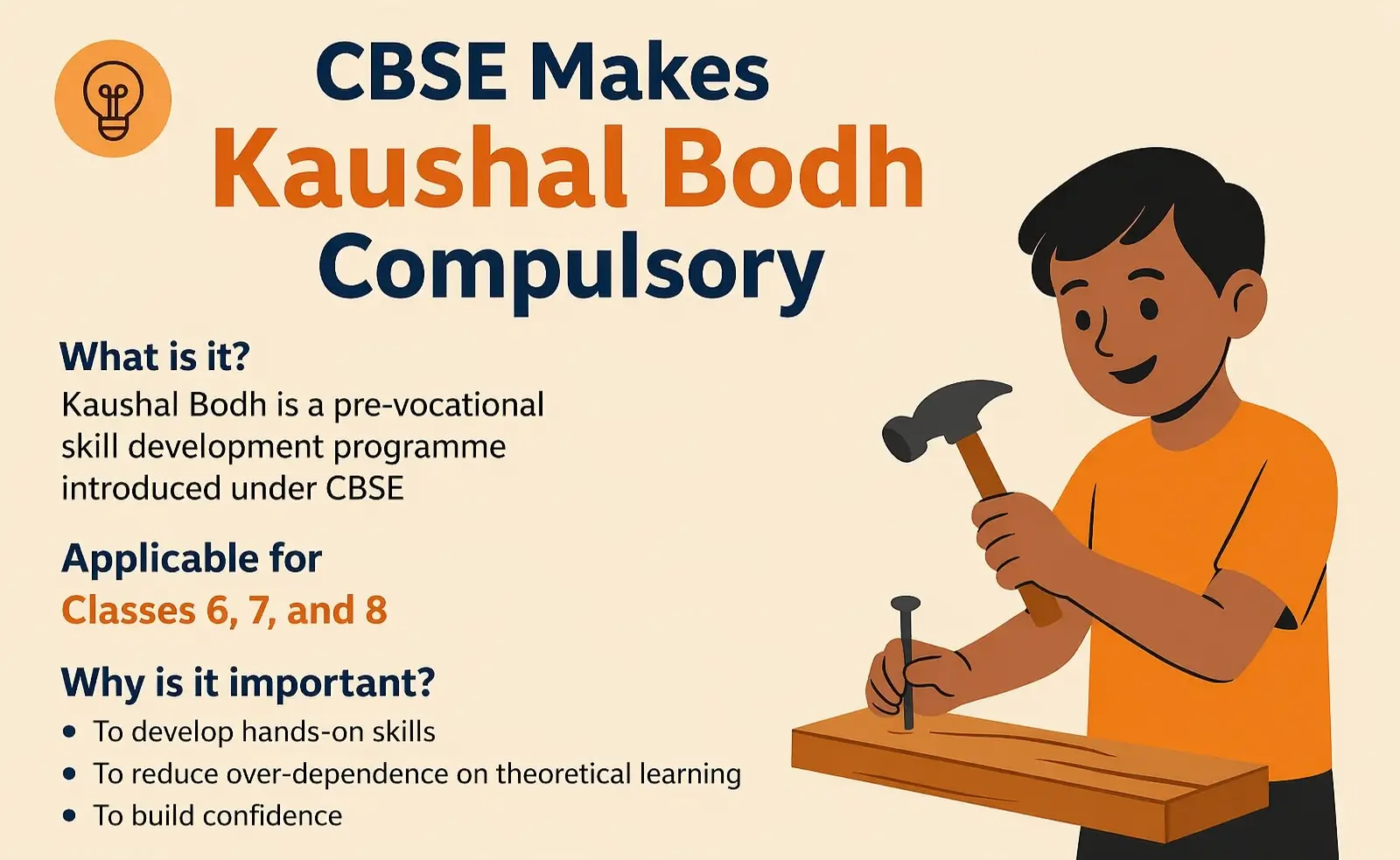
Q. What is Kaushal Bodh and what does it mean?
Answer: Kaushal Bodh is a mandatory skill-based education subject introduced by CBSE for Classes VI to VIII under NEP 2020. The name means Skill Awareness in Sanskrit — Kaushal means skill and Bodh means knowledge or awakening. It focuses on hands-on, project-based learning in three areas: working with nature and life forms, working with materials and machines, and working in community and human services. It was made compulsory from the 2025-26 academic session.
The NEP 2020 Connection: Why India Needed Kaushal Bodh
For decades, the dominant measure of a good student in India was marks. The child who scored 95% in boards was celebrated; the child who could fix an electrical appliance, grow vegetables from seed, or organise a community event was rarely recognised in the same breath. This created a deeply lopsided education system — one that produced graduates who could recall textbook answers but often struggled with the practical demands of adult life.
NEP 2020 was designed to correct this. One of its most ambitious targets: at least 50% of students in India should have access to vocational and skill-based education by 2025. Kaushal Bodh is how CBSE delivers on that target for the critical middle school years — the ages of 11 to 14 when children begin forming their identity, their sense of capability, and their early ideas about what they want to do with their lives.
The subject does not compete with Mathematics or Science. It complements them. A child who has grown a plant understands biology differently. A child who has made a clay pot understands physics of pressure and form differently. A child who has planned a budget for a school event understands arithmetic differently. Kaushal Bodh is experiential learning that makes everything else stick better.
The Three Forms of Work: The Architecture of Kaushal Bodh
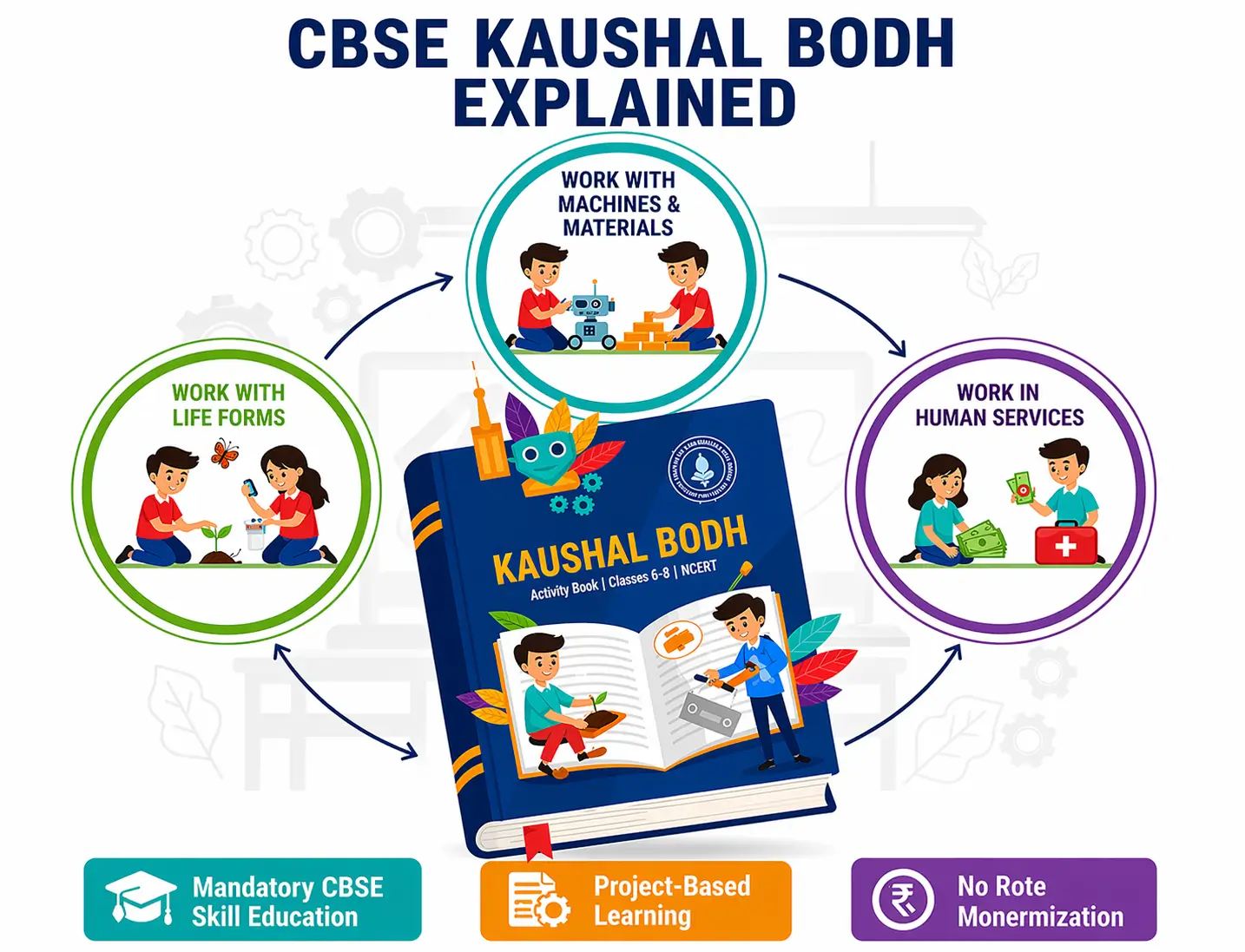
Every project, every activity and every assessment in Kaushal Bodh fits into one of three fundamental categories of work. Understanding these three categories is the key to understanding why any given task exists in the curriculum and what it is training a child to do.
1 — Work with Life Forms
This category covers interaction with the living natural world: plants, animals, food, soil, ecosystems and the environment. Gardening, composting, growing medicinal herbs, food processing, animal care and conservation belong here.
The deeper purpose is significant. In a country where millions depend on agriculture and where environmental degradation is a major challenge, exposing every middle school student to working with life forms builds ecological awareness, respect for food systems, patience, observation, and a grounded understanding of nature.
2 — Work with Machines
This category covers activities involving tools, materials, and technology to create, repair or transform things. Paper craft, pottery, block printing, embroidery, digital design, basic repairs and introductory coding belong here.
The deeper purpose is significant. A student who learns to handle tools, shape materials or fix simple objects develops physical confidence, problem-solving ability, creativity, and independence. This builds practical understanding and the belief that they can engage with and shape the material world in real life situations effectively.
3 — Work in Human Services
This category covers activities involving care, communication and service to people and communities. Hygiene campaigns, peer mentoring, clean-up drives, health education, service events and hospitality awareness belong here.
The deeper purpose is significant. A student who participates in service work develops empathy, communication skills, responsibility, and social awareness. This builds confidence in working with people and prepares them to contribute meaningfully to society and community life in diverse real world situations.
Kaushal Bodh Class 6 Curriculum — Foundation Level (2025-26)
Class VI is where the Kaushal Bodh journey begins. The curriculum at this stage is intentionally accessible and exploratory. The goal is not mastery — it is ignition. CBSE wants every 11-year-old to discover that they are capable of doing something real, and to begin building curiosity about the world of work.
Official CBSE Curriculum — Class VII Kaushal Bodh (Session 2025-26)
Unit 1: Kaushal Bodh Work with Life Forms
Local cooking, food processing, food preservation techniques (pickling, drying), traditional recipes documentation
Unit 2: Work with Materials
Upcycling projects, pottery, block printing, basic embroidery, handicraft creation from waste materials
Unit 3: Work in Human Services
Peer support activities, community service roles, service event planning, outreach campaigns
Unit 4: Financial Literacy & Marketing
Basic budgeting, income and expense concepts, buying and selling, value of money, simple marketing ideas
Sample projects at this level include a Gardening Project (students grow a plant from seed and document its growth over 4-6 weeks), a Paper Craft Workshop (creative reuse of paper into decorative or functional items), a Hygiene Awareness Drive (students create a hygiene checklist and present it to their class), and a Waste Sorting Challenge (sorting everyday waste and learning what can be recycled).
The learning outcomes at Class VI level — curiosity, teamwork, basic tool usage, and ecological awareness — look simple on paper but are foundational in practice. A child who finishes Class VI Kaushal Bodh knowing how to work with a team, handle basic tools safely, and understand why waste needs sorting has built a scaffold of practical intelligence that will serve them for decades.
Kaushal Bodh Class 7 Curriculum — Applied Level (2025-26)
By Class VII, students are ready for more complexity, more initiative and more community connection. The curriculum at this level is designed to build on what was explored in Class VI and take it somewhere more purposeful. Students are expected to plan their projects, collaborate in teams with clearer roles, and connect their activities to the world beyond the school gate.
Official CBSE Curriculum — Class VII Kaushal Bodh (Session 2025-26)
Unit 1: Work with Life Forms
Local cooking, food processing, food preservation techniques (pickling, drying), traditional recipes documentation
Unit 2: Work with Materials
Upcycling projects, pottery, block printing, basic embroidery, handicraft creation from waste materials
Unit 3: Work in Human Services
Peer support activities, community service roles, service event planning, outreach campaigns
Unit 4: Financial Literacy & Marketing
Basic budgeting, income and expense concepts, buying and selling, value of money, simple marketing ideas
Class VII is where financial literacy enters the picture for the first time — and it does so in a practical, non-threatening way. Students do not study economics theory. They plan the budget for a small school event, or calculate the cost of ingredients for a cooking project, or estimate how much a community awareness drive will cost. These are the financial skills that most adults wish they had learned at 12 rather than 30.
The handicrafts component of Unit 2 is also culturally significant. India has one of the richest craft traditions in the world — pottery, weaving, embroidery, printing — many of which are endangered because young people have not been introduced to them. Class VII Kaushal Bodh creates that introduction, and for some students it will be the beginning of a lifelong relationship with a craft tradition that is part of their inheritance.
Kaushal Bodh Class 8 Curriculum — Advanced & Career Awareness Level (2025-26)
Class VIII is the most ambitious and defining year of the Kaushal Bodh programme. By this stage, students have already explored different forms of work with curiosity in Class VI and applied their learning with a sense of community purpose in Class VII. These earlier experiences provide a strong foundation for deeper engagement and reflection.
In Class VIII, the curriculum asks something more. It encourages students to begin seeing themselves as capable individuals who have something real and meaningful to offer to the world around them. They are expected to take greater ownership of their work, approach tasks with confidence, and think more independently. This stage focuses not just on doing activities, but on understanding their value and purpose.
At the same time, students are guided to make conscious connections between the skills they are building today and the life choices they will make tomorrow. This process helps develop self-awareness, clarity, and a sense of direction. It prepares them to think about their future with maturity and confidence, while staying grounded in real-world skills and experiences.
This final stage also encourages students to reflect on their personal strengths, interests, and aspirations in a more structured way. Through guided activities and experiences, they begin to recognise patterns in what they enjoy and where they perform best, helping them build confidence in their abilities and make more informed choices about their future paths.
Official CBSE Curriculum — Class VIII Kaushal Bodh (Session 2025-26)
Unit 1: Work with Life Forms
Herbal products preparation, advanced food preservation, horticulture techniques, agri-entrepreneurship concepts
Unit 2: Work with Materials
Digital poster design, basic household repair, design thinking methodology, making of a graphic novel or photo story
Unit 3: Work in Human Services
Community service project (student-led), tourism and hospitality awareness, health awareness campaigns
Unit 4: AI & Technology Literacy
Introduction to coding (block-based), digital citizenship, responsible AI use awareness, data basics
The inclusion of AI and technology literacy in Class VIII Kaushal Bodh is one of the most forward-looking decisions in the entire curriculum. The students sitting in Class VIII today will enter the workforce in the 2030s and 2040s — a world in which artificial intelligence will be present in virtually every profession. Introducing them now, at 14, not with fear but with curiosity and basic competence, is exactly the right response.
Class VIII is also when career awareness becomes an explicit learning outcome. This is timely. As students approach the critical stream-selection decision at the end of Class VIII and into Class IX, Kaushal Bodh gives them actual data about themselves — what they enjoyed, what they were good at, what frustrated them — to make a more informed choice than pure marks-based streaming allows.
What is the Kaushal Bodh curriculum for Class 6, 7 and 8?
Answer: The Kaushal Bodh curriculum has three levels: Class 6 (Foundation) covers gardening, paper craft, hygiene awareness and green skills; Class 7 (Applied) covers local cooking, upcycling and pottery, community service, and financial literacy; Class 8 (Advanced) covers herbal products, digital poster design, community service projects, and AI and coding literacy. All levels follow the same three-form structure: work with life forms, work with materials, and work in human services.
CBSE Skill Modules: More Than 30 Options Available Alongside Kaushal Bodh
On top of the core Kaushal Bodh textbook, CBSE has published more than 30 supplementary skill modules that schools can choose to use alongside or after the main curriculum. These are all available free of cost on the official CBSE website.
The variety is extraordinary — a school in a mountainous region might choose the Tourism module; a school near a craft cluster might add Pottery or Embroidery; a city school with good tech infrastructure might layer in Coding, Data Science or Digital Citizenship. Some of the most educationally significant modules include:
- Artificial Intelligence (Code 901) — foundational AI concepts, how AI works, ethics and applications
- Design Thinking and Innovation (Code 903) — structured creative problem-solving across disciplines
- Financial Literacy (Code 904) — money, savings, banking basics and consumer awareness
- Coding (Code 910) — block-based and introductory coding for Classes VI, VII and VIII
- Digital Citizenship (Code 913) — responsible, safe and ethical online behaviour
- Pottery (Code 919), Block Printing (Code 920), Embroidery (Code 930) — traditional Indian craft skills
- Herbal Heritage (Code 924) — identifying and using India's medicinal plant traditions
- Photography (Code 934) — composition, storytelling and ethical image making
- Mass Media Literacy (Code 908) — critically reading and evaluating news and advertising
All modules are updated each session and downloadable from cbseacademic.nic.in/skill-education-books.html.
Kaushal Bodh Assessment Pattern: How Students Are Evaluated
This is almost certainly the question parents ask most often — and the answer consistently surprises them. Kaushal Bodh does not have a written board examination. There is no annual paper, no half-yearly test, no marks-based ranking system.
This is intentional and well-reasoned. The entire purpose of Kaushal Bodh is to build practical skills and genuine capabilities. If we evaluate those skills using the same written-test model we use for History or Biology, we defeat the purpose entirely. A written exam cannot tell you whether a child can grow a plant, plan a budget or present a project confidently. So CBSE has built a different model.
The Four Pillars of Kaushal Bodh Assessment
1 Portfolio Assessment
Students maintain a portfolio of every completed project throughout the academic year — photographs, written reflections, sketches, teacher feedback and self-evaluation sheets. This document records the child's full learning journey.
2 Teacher Observation
The teacher continuously observes and records each student's participation, attitude, effort, teamwork, safety awareness, and skill development through structured classroom observation — not a one-time inspection but an ongoing documentary record.
3 Formative Assessment
Low-pressure quizzes, group discussions, self-evaluation sheets and peer review sessions are held at regular intervals to capture learning in a conversational, non-competitive environment.
4 Project Presentation
Students present their completed projects to classmates, teachers or a wider school audience — building the public speaking, communication and self-advocacy skills that a written test can never develop. This is the performance element of skill assessment.
For parents used to tracking their child's progress through mark sheets, this model requires a genuine mindset shift. The question to ask is not 'What did my child score?' but 'What did my child make, do, and learn?' The portfolio is a far richer record of capability than any percentage grade.
Q. Does Kaushal Bodh have a written examination?
Answer: No. Kaushal Bodh has no written board examination or written test of any kind. Students are assessed through four methods: a project portfolio maintained throughout the year, continuous teacher observation of skills and participation, formative assessments including quizzes and group discussions, and oral project presentations. The assessment focuses entirely on practical skill development and holistic growth rather than memory recall.
21st Century Skills That Kaushal Bodh Builds
Education researchers and global organisations including the World Economic Forum consistently identify the same cluster of skills as most critical for success in the 21st century — often grouped as the 4 Cs: Critical Thinking, Creativity, Collaboration and Communication. These four skills are not taught in Kaushal Bodh through lectures; they are developed through doing.
When a Class VII student plans a community awareness campaign, she is practising critical thinking (diagnosing the problem), creativity (designing the message and materials), collaboration (dividing tasks with teammates), and communication (presenting the outcome). These four skills operate simultaneously in every real-world task — and Kaushal Bodh is designed to mirror real-world tasks rather than abstract academic exercises.
Beyond the 4 Cs, the subject also builds a set of skills that are harder to name but equally important:
- Green Skills — the ability to make environmentally conscious choices and contribute to sustainability
- Financial Literacy — understanding value, budgeting and the basics of economic exchange
- Digital Literacy — especially strong at the Class VIII level with coding and AI awareness
- Cultural Heritage Awareness — connecting students to India's craft, food and agricultural traditions
- Dignity of Labour — perhaps the most important outcome of all: genuine respect for all forms of work
That last one — dignity of labour — is something that no subject has systematically tried to build in Indian school education before. Kaushal Bodh changes that by making every child do the kinds of work that are often invisible or undervalued in our society: growing food, crafting objects, cleaning spaces, helping neighbours. When a child has done these things themselves, they cannot dismiss them as lesser work again. That is a profound shift in social consciousness, built one project at a time.
Kaushal Bodh Textbooks and Resources: Where to Download
All official Kaushal Bodh materials are completely free and available to download from the Government of India's education portals. Here is exactly where to find them:
- CBSE Academic Unit (cbseacademic.nic.in/skill-education-books.html): Kaushal Bodh textbooks for Classes 6, 7 and 8 in English and Hindi. Also contains all 30+ supplementary skill module books, teacher handbooks, and sample assessment tools. Always use the Session 2025-26 versions.
- NCERT (ncert.nic.in): Kaushal Bodh textbooks in regional languages including Bengali, Gujarati, Tamil, Telugu, Marathi, Punjabi, Urdu and more. Also available on the ePathshala app for offline reading on mobile devices.
- CBSE Skill Education Portal (cbseacademic.nic.in/skill-education.html): Complete curriculum framework, teacher training modules, and the full list of skill subjects available at every level from Class VI to Class XII.
These resources are updated at the beginning of each academic session. Parents and teachers should always verify they are accessing the current year's materials, particularly after any CBSE circular updating the Kaushal Bodh framework.
Conclusion: Kaushal Bodh Is Education Finally Catching Up with Life
There is a quiet revolution happening in India's middle school classrooms. While no one is shouting about it, Kaushal Bodh is doing something that generations of education reform have failed to do: it is making school work feel like work. Real work. Work that matters. Work that a child can be proud of.
A student who has grown a plant knows patience. A student who has planned a budget knows responsibility. A student who has organised a community drive knows leadership. A student who has repaired something that was broken knows confidence. These are not soft skills — they are the hard, lasting foundations of a capable human being.
India needs its next generation to be not just educated but skilled. Not just employed but capable. Not just qualified but confident. Kaushal Bodh is a step — a meaningful, concrete, classroom-level step — in that direction. Understanding it, supporting it, and celebrating it is something every parent, educator and citizen has a stake in.